Showing posts with label enix. Show all posts

Monday, March 12, 2012

Taking The World With You: Dragon Quest


Dragon Quest (Dragon Warrior, if you want to be precise) was a revolution upon release. Today, it garners the respect it deserves for laying the foundation for an entire genre, but that's generally where the appreciation ends. Modern games have refined Dragon Quest's core concepts to the point where its primitive presentation and gameplay are difficult to go back to. But what's been tossed aside alongside the genre's advancements and upheavals and do these morsels deserve better treatment? Far from decrying what's been lost, let's take a look at the more esoteric elements of Dragon Quest that have been gradually chipped away over the years.

Remember drawing maps for video game dungeons? I don't, because I was born far too late to hop on that gravy train, but Dragon Quest practically demands the practice. While the world is an alarmingly small one, Dragon Quest provides you with no map or navigational tools. Towns, cities, and landmarks are all defined by cardinal directions, and dungeons are terrifying gauntlets with no easy way to navigate them. Unlike the illuminated dungeons of The Legend of Zelda, the dungeons in Dragon Quest are pitch black, safe for the four blocks lit up around you. With a Torch in hand, those four lit up spaces become a 3x3 lighting box, allowing easier exploration of a dungeon's labyrinth design. Alas, the high encounter rate inside dungeons provides a more pressing issue to deal with than your limited vision, and dungeons are frequently tackled via multiple trips to and from the nearest Inn. Each trip gradually unlocks more of the dungeon as you travel down new routes but, unless you have a fantastic memory, you'll need to crack out pen and paper to start mapping your progress.

The process of note taking in games has been largely swept aside by modern game developers and replaced with automated maps or helpful signposting. Detractors argue that a game should contain every element of play nestled inside its code, and any external elements are irrelevant. This dismisses what we bring to games by simply playing them, and each stroke of line on a piece of paper designating a dead end represents a hard fought victory, a sinking realisation, or a satisfactory conclusion to our adventure. When people dismiss the simplistic interaction of Dragon Quest, they neglect the exploration and map drawing - exploring the world and familiarising yourself with your surroundings - as a fundamental part of your actions. The turn-based combat is fast and efficient; it's a distraction more than the centre piece of the experience.

No, what's important in Dragon Quest is the hard fought ground you cover each time you set out from the safety of a village. When you emerge from that last dungeon with a veritable tome of knowledge resting on your lap, there's an immense feeling of satisfaction. More than simply having your achievements frozen inside a cartridge, they've claimed an irrefutable permanency beyond an NES chip. A quest, indeed.
Dragon Warrior maps (1)

Monday, July 18, 2011

On the Games of Yesteryear

I'm horrible at 2D platformers.

I place my inability to play them originating from jumping into the video game world during the Nintendo 64 era. The 2D plain was thrown out by the majority of developers world wide and blocky, polygonal 3D was the next big thing. Banjo Kazooie and Ocarina of Time were my mentors and I learned the joys of navigating through spaces that suddenly required depth perception. Jumps were a bit more forgiving, combat was more dynamic (and even let you avoid encounters should you so wish) and 3D space was much more conducive to slower, more methodical play. You can clamber on top of a hill and look out at a vast expanse of land, plan a route and move towards it whichever way you wished. You can take your time. 2D platformers have enemies moving towards you almost constantly; they're a reactionary game more than a preemptive one. There are benefits to both styles but the style that I grew up with severely limited my ability to enjoy the other one. To compound this further, I loved RPG's and their menu based systems. After years of these types of games, my reaction times were all but blunted. That's not to say I can't enjoy 2D platformers. It's more a matter of persevering through my overwhelming lack of ability. Then, and only then, can I ultimately enjoy them. That sounds hateful but my intention is otherwise.


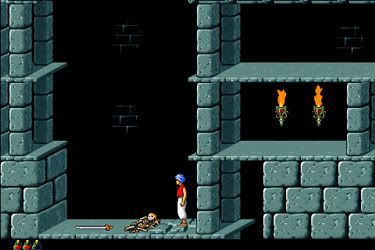
The very first video game I played was Prince of Persia; a remarkable 2D platformer by Jordan Mechner. I love that game but it comes from a different pedigree of game design in comparison to Mario. The plumber emphasises momentum and the exuberance of movement. The screen scrolls with Mario's leaps and bounds and encourages constant progression. Prince of Persia focuses more so on realistic animation; a standing jump propels the prince upwards and a running jump only reaches so far, regardless of how long you hold down the button. This changes the level design and general mentality of the player significantly. The pixel perfect jumps of the Prince lend themselves to precise environmental hazards unlike the wide open blocks of land featured in a typical Mario level. This design difference promotes a more methodical, cautious style of play; almost puzzle like. By treating the Prince's move set as the tools the player uses to solve the puzzles in the game, Mechner designed Prince of Persia as such to embrace it's more cerebral play style. A scrolling screen was replaced with a more traditional static image, allowing the player to stop and assess the various jumps, pits, enemies and general level design of each screen before deciding how they would best progress through it. It's a game that demands perfection and the challenge grew from executing the perfect run once you discovered the optimal way to complete each level. It was hard but it wasn't reflex intensive like Mario, Sonic and Eastern developed platformers in general. Even if the combat in Prince of Persia was the most reflex heavy part of the game, the detailed animation made it significantly easier to predict and counter the enemies attacks. Again, it was a game of observation over fast reflexes.


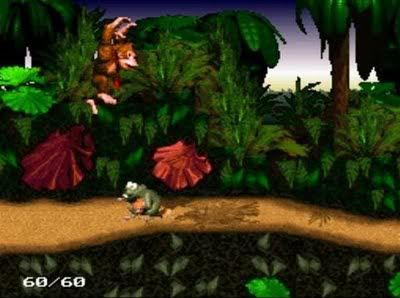
The Donkey Kong Country series is an example of infuriating platformer design (or at least the ones on the SNES were). It wasn't the controls, even if they were a little bit loose, and it wasn't even the strong focus on reflexes. No, the problem came about from the unusual raised camera perspective. In the effort to make their game look as 3D as possible, Rareware implemented a perspective that placed a horizon line on almost every surface, meaning that it was extremely difficult to determine exactly when to jump near the edge of a cliff. Suffice it to say, there were countless amounts I simply ran off the edge. Not content with one annoyance, Rareware also pushed the camera far to close to our simian friends, giving the player less than optimal time to prepare for the onslaught of shit that frequently ran towards you from the right side of the screen. Oh, Donkey and Diddy were also positioned alarmingly close to the middle of the screen which only further exacerbated the lack of preparation one had for the rampage of enemies. Mario, at the very least, always gave the player a considerable amount of time to recognize and react to the threat.


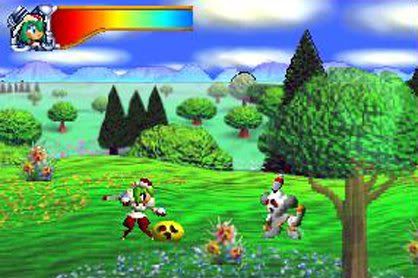
Or how about a game where there wasn't much of a threat at all in standard gameplay? Mischief Makers paired the diverse movement set of the Prince with the hurried, momentum based platforming of Mario to great effect. Here the player assumed the role of Marina, a green haired robot girl, as she sought to rescue her creator, Professor Theo. Being a robot, Marina is gifted with an array of interesting movement possibilities beyond the simple leap. She can dash across ground and sky with her boosters, slide across the dirt in a similar fashion to Mega Man and most enjoyable of all... pick up things and shake them! Rather than embrace the realistic movement of the Prince, Marina expands upon the momentum based platforming of Mario with a move set that emphasises speed. Once the player figures out Marina can leap after activating her slide boost to gain a significant burst in speed and sizable air time, environments become a playground for speed runs. There are little to no hazardous jumps in any of the levels and many of the stages act as short puzzle vignettes, encouraging the player to rush through the level with bold movements, exploiting every possible deviation of Marina's abilities. Mischief Makers thrives on the simple joy of controlling an extremely acrobatic character.


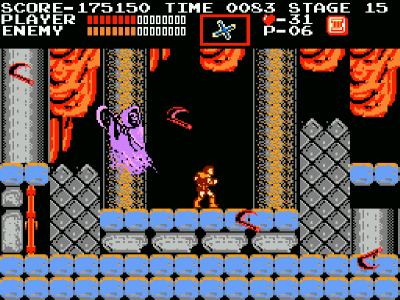
Castlevania, as a whole, is another interesting divergent of the platforming genre focusing on rhythm, momentum and timing. It's a combat heavy series that places huge importance on forward progression. Each enemy encounter has a specific attack routine that must be memorised and exploited to proceed. Many of the enemies you face take one or two hits to dispatch meaning that room and level design as a whole come together harmoniously in a very rhythmic, pattern based fashion that promotes flow; the player gets so absorbed in the activity that nothing else seems to matter. It's a much more designed experience than most games which is honestly surprising considering the breadth of gameplay elements included in the series.

Maybe I do like 2D platforming games after all. I prefer the ones with the more off-kilter gameplay design though. 2D platformers that only have a jump button are anathema to me. While I appreciate limiting the actions of the player controlled avatar can encourage intricate level design and more thoroughly exploit a single gameplay hook to it's fullest, I enjoy the chance to control a character with a full suite of abilities at their disposable. They feel more like a real person and less like a little blob of migs and megs.